
Competitor GEO Comparison
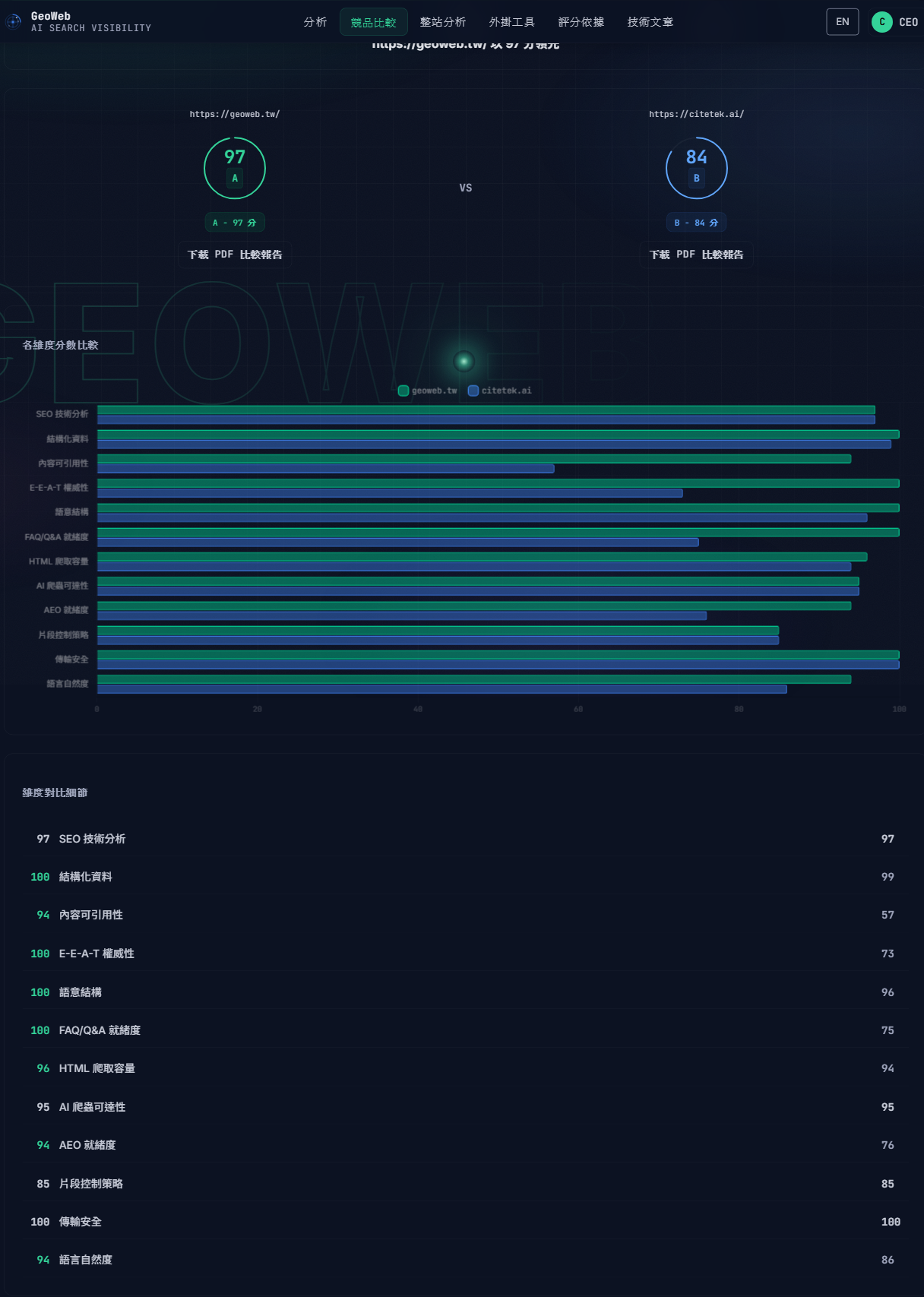
Your site and your competitor's each get a 12-dimension GEO audit, lined up dimension by dimension: where you win, and which gaps explain why a rival gets cited instead. That's the site side; what the engines actually say about you, and whether they put you first, is what AI citation backtesting covers.
What this tool tells you
- Why AI engines mention your competitor but not you — see the per-dimension score gap and pinpoint where they outperform you.
- Where the gap concentrates — is it on-page SEO, structured data, E-E-A-T authority, language naturalness, or AI crawler accessibility?
- What to fix first to catch up — gaps are sorted by magnitude so you get a concrete priority list, not a wishlist.
What gets compared: 12 dimensions, 3 axes
Unlike pure SEO rank tracking, GEO assessment spans three axes:
- GEO health (on-page structural readiness) — SEO technical, structured data, E-E-A-T, language naturalness, citation density, and other 12 items.
- Agent friendliness — whether AI agents and crawlers can correctly locate your content, identify your service, and read which callable interfaces you publish (robots.txt, llms.txt, .well-known/* protocol-layer declarations, plus a few behaviour checks such as whether a non-existent path returns a real 404; all of it is plain GET requests to public URLs — we never call your APIs).
- Off-site visibility — your site's Google/Bing index coverage, sitemap health, social presence, and other external signals.
Who should use this
- Marketing leads planning GEO budget — quantitative baseline for reporting "we're N points behind competitor X".
- Decision-makers evaluating GEO services ROI — baseline before, progress during, validation after.
- Brand owners — who intuitively feel "ChatGPT recommends my competitor, not me" and want to understand why.
How is this different from SEO competitor tools
Traditional SEO competitor analysis looks at search-result-page rankings, backlink counts, monthly traffic — metrics that assume users will scan ten blue links and click through.
GEO comparison looks at whether mainstream AI engines will cite your content when generating an answer to a user's question. The scoring model is built around AI citation mechanics (structured data density, machine-parseable FAQ/How-to/tables, E-E-A-T signals, language naturalness, agent accessibility), overlapping with SEO indicators but emphasizing different things.
Don't want to do it yourself after reading the report? Our managed GEO service handles it end to end.
FAQ
How long does a comparison take?
Usually 1–3 minutes. Both sites are analyzed in parallel; results are shown as a side-by-side table plus a radar chart.
Do both URLs need to be publicly accessible?
Yes. The tool fetches pages using user-agents commonly used by mainstream AI crawlers. Sites behind a firewall, robots block, or login wall will fail to analyze.
How is this different from a single-page GEO check?
Single-page check audits one URL you provide. Comparison runs you and your competitor through the same 12-dimension assessment so you can see the per-dimension gap.
Who can use this?
Competitor comparison is an advanced feature enabled per account. Sign in, then contact [email protected] or book a demo at the bottom of this page and we'll switch it on — unlimited runs once enabled. Free accounts can use the single-page audit on the homepage meanwhile.
Will my competitor know I compared them?
No. The fetch comes from GeoWeb's backend. Their server will only see one anonymous GET request — they cannot see that a comparison happened.
Can I export the results?
Comparison results are saved to your account history under "My Analyses". PDF export is on the roadmap.