

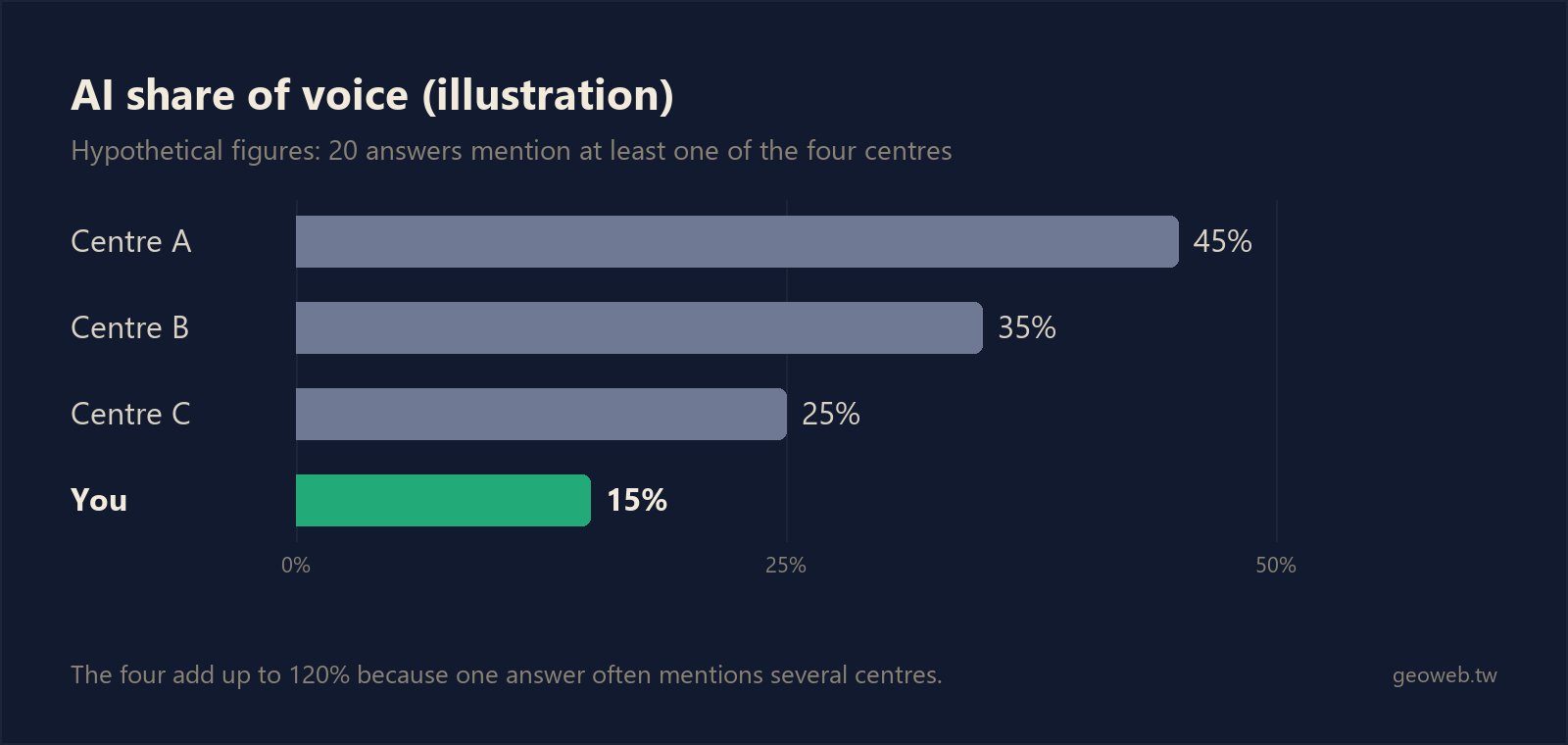
More and more marketing agencies are turning up to pitches with an “AI share of voice” bar chart. The one below is what we imagine a postpartum care centre in Zhubei, Hsinchu, might be shown: you on 15%, the three other centres in the area on 45%, 35% and 25%. The salesperson’s reading is that when customers ask AI to find a postpartum care centre, you’re a third as likely to come up as the leader.
Let’s make our position clear from the start: if the data behind a share figure covers only a handful of questions, each asked just once, do not take it at face value, and certainly don’t use it to decide whether to sign.
That’s not to say those numbers are made up. Ahrefs, which makes SEO tools, sells exactly this number through its own product, and on 22 October it even went to the trouble of publishing a long post explaining how it’s calculated. The calculation itself is simple: put a set of questions to ChatGPT and Gemini, collect the answers that mention you or a competitor, and see what share of them mention you. That’s all there is to it. The problem lies in what comes after: who wrote the questions, how many rounds were run, and who you’re compared with are all decided by whoever does the measuring.
Twenty answers: one either way is 5 percentage points
Take the chart above. Say twenty answers mention at least one of the four centres and you’re in three of them; that’s 15%. One more and it’s 20%; one fewer and it’s 10%.
AI never answers exactly the same way twice, and the same question asked today and next week can come back with a different list. So if the questions are only asked once, a swing of 5 or 10 points can turn up any time, and the 15% you’re looking at may just be how that particular day went.
Ahrefs itself recommends watching the trend over several periods rather than any single jump. A share from one round doesn’t even have a trend yet.
Put your name in the question and the number looks great
The easiest place to pad the number is the questions. Ask “What are the reviews like for [your centre] in Zhubei?” and your name is already in the question, so AI will almost certainly mention you; put a few of those in and your share goes up.
But what you want to know is whether AI thinks of you on its own while customers are still deciding where to go. When customers are actually choosing, they tend to ask long questions with their conditions thrown in, like “Is there a postpartum care centre in Zhubei where my older child can stay with us and a paediatrician comes round every day?” If every question is short, like “best postpartum care centre Zhubei”, all you’re measuring is the list everyone gets onto.
One more detail. Ahrefs’ tool weights questions by how many people search Google each month for what they’re about. Our own guess is that hardly anyone types a long, conditional question like that into Google, so this method gives it very little weight, even though it’s the kind of question that best shows whether customers will pick you.
Change the competitors and the number changes
Who picked those three competitors? If they’re the three biggest centres in the area with the heaviest advertising, coming last is no surprise; swap in centres your size at your price and the number could look completely different.
How many competitors there are matters too. Against one, 20% means the other business takes most of it; against nine, 20% could already put you near the top. So when you hear “the industry average is such-and-such”, ask whether the questions and competitors behind it match yours. If they don’t, that average has nothing to do with you.
Which AI tools were asked needs pulling apart as well. If all you get is one total, ask for separate figures for ChatGPT and Gemini, because once they’re combined, doing badly in one can disappear completely.
Ahrefs gives an example: drop your biggest competitor, add 50 questions you were already strong on, stop asking an AI tool where you do badly, and the number goes up. As they put it, you changed the ruler, not your visibility.
Even an accurate number can’t tell you how AI describes you
This is the part that matters most. Share of voice can only count whether AI mentions you; it doesn’t look at what AI actually says about you when it does, and Ahrefs notes this plainly in its own post.
Being mentioned could mean AI puts you first as a recommendation, with your room types and prices right. It could mean a line tacked on at the end: “There’s also [your centre], though some people online say the rooms are a bit dated.” Or it could mean a package you dropped two years ago, at the old price, described as if it were current. All three count once. So a rising share doesn’t mean customers are hearing better things about you; it could just be the same wrong description turning up for more questions.
Whether a customer picks up the phone to book a visit depends on how AI describes you. There’s no percentage for that; you have to read the answers, one by one.
When you get the report, ask for these first
Next time a salesperson brings you a share of voice figure, ask them to include the list of questions, how the competitors were chosen, which AI tools were asked, how many rounds were run, and the full text of the answers that mention you. If they can’t produce those, ignore the number for now.
A number worth looking at needs plenty of questions, written the way customers actually ask, fixed once written and put to AI again with the same set at regular intervals, with each AI tool recorded separately and every round’s answers kept for comparison. That’s called backtesting. And numbers alone still aren’t enough: someone has to read the answers one by one and check them against your current room types, prices and services before you know whether AI is getting you right.
That whole routine is what our managed GEO service does: put the same set of questions to each AI tool at regular intervals, check whether it mentions you, recommends you and gets you right, and where it gets you wrong, go back and fix your website content and what’s said about you elsewhere. You just look at the results.
If you’d like to know how AI describes you right now, you can book a demo with one of our consultants. The consultant turns the conditions customers in your line of business usually bring into questions, puts them to ChatGPT there and then, and you read the answers that mention you together; if you’ve got a share of voice report from someone else, bring it along and compare. The same session also covers your website’s GEO audit score. The audit is free, and it looks at whether AI can understand your website.
Further reading
- How to Choose an AI Brand Visibility Tool? An Honest 2026 Tool Map — Tools that calculate share are just one category: what each kind of tool can answer, and what none of them can
- From keywords to intent: AI now picks businesses by the customer’s checklist — Customers put their conditions to AI in a full sentence, and that sentence rarely maps to an existing keyword
- AI reads the reviews for your customers, and old complaints still count — The line that mentions you may carry reviews from years ago