

Open Google Search Console and, under Performance, you’ll find a report that covers generative AI features and is still marked Beta. It counts how many times your pages were shown in Google’s AI Overviews and AI Mode. Since November 9, the handful of sites we track have shown the same pattern in that report: pages about the company itself, such as the home page and service pages, have dropped only a little, while content pages such as articles keep falling. Sites whose content is mostly generated by AI are falling hardest, and sites whose content is mostly written by people are actually going up overall.
Our read is that this isn’t ordinary fluctuation but a major trend driven by the newest generation of AI models. This time around, Google’s AI Overviews have started to favor a business’s own official pages and pass over content pages, and that among content pages they now take into account whether an article was generated by AI, with the penalty applied quietly. There is no announcement and no warning email, and impressions in regular search drop only a little, while citations in AI Overviews fall by a lot. If most of the articles on your website were written by AI in one pass and pasted straight in, now is the time to look after your official pages first and then have someone rewrite your important content pages.
One site rises and the other falls, yet they move in step every day
Start with the chart. Each line is one of the sites we track. The blue site has few content pages, and most of its content is written by people; the orange site has many content pages, and most of its content is AI-generated. We know how the articles on each site were produced. The two sites are very different in size, so each is compared with its own average from October 26 to November 8, which shows whether it went up or down relative to itself. The three shaded days (November 9 to 11) are days for which Google has said this report under-counted impressions, so we leave them out of the comparison and start counting from November 12.
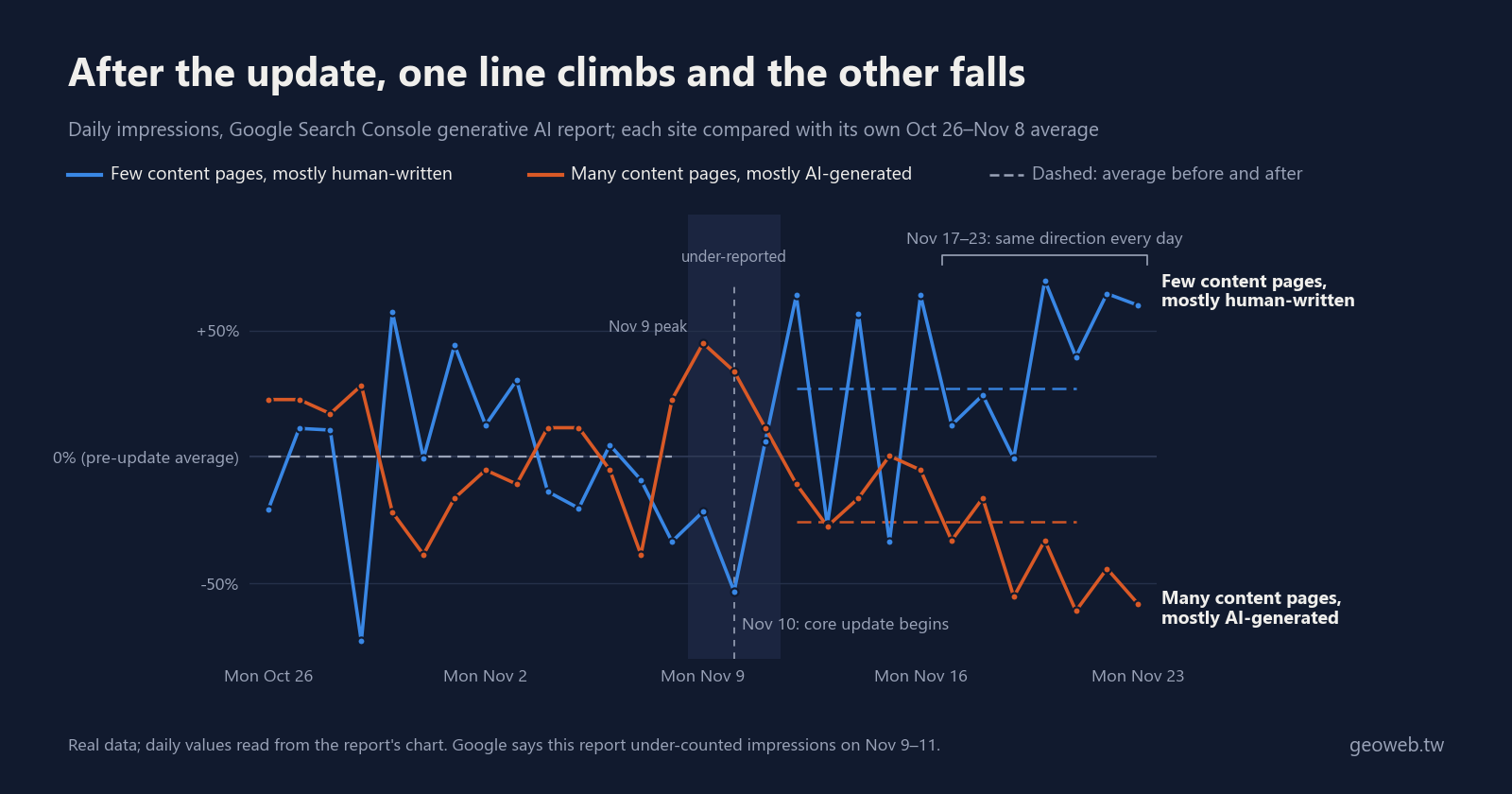
Over the ten days from November 12 to 21, the blue site didn’t drop at all; its average daily impressions were actually higher than in those two weeks at the end of October. The orange site’s were down by about a quarter. The chart shows AI Overviews only. Over the same period, the orange site’s impressions in regular search fell by less than a tenth. Regular search did drop over the last three days as well, but on those same three days the site’s AI Overviews impressions were cut in half. So it isn’t that the whole site got weaker in Google; the part being pulled down hardest is AI Overviews.
The stranger part is the rhythm of the two lines. Over the seven days from November 17 to 23, the two sites moved in the same direction every day: both down on Tuesday, both back up on Wednesday, down again on Thursday, up again on Friday, down together once more on Saturday, back up together on Sunday, and down together again on Monday. In the month or so before the update, it was a different story: whether the two sites moved the same way on a given day was about as random as a coin toss, even with the same weekly cycle, and each line wobbled on its own. The two sites started rising and falling together because the same daily shifts on Google’s side are now driving both of them. But within that same system, one site keeps getting credit and the other keeps getting marked down, which is why one line goes up overall and the other goes down.
That also shows it isn’t ordinary fluctuation. Fluctuation would bounce up and down around where the line started and come back after a while. These two lines have each moved in one direction since November 9 and still hadn’t turned back by November 23, and their ups and downs are tied to the same rhythm. That’s what it looks like when the system that picks sources has changed how it works.
This round, AI Overviews kept official pages and passed over content pages
Two things on Google’s side line up with the timing. The orange site peaked on November 9, and the very next day Google began rolling out its November core update, which didn’t finish until the 24th. The orange line has been falling ever since, and it was still going down on November 23. On November 12, AI Mode switched to Google’s newest default model, Gemini 4 Hydrogen, and Google said it would also be used for the hardest questions in AI Overviews. Google didn’t say that either change altered how AI Overviews choose their sources; the only thing it said about sources was that AI Mode would link to a broader range of sites than before. Still, this round began while Google was rolling out a core update and moving AI Overviews and AI Mode onto its newest model at the same time, so don’t wait for it to reverse on its own; Google has already announced another core update for December. But on November 23, US SEO consultant Lily Ray shared numbers from a handful of sites she tracks: pages stamped out from one template thousands of times saw their citations in AI Overviews and AI Mode drop after the update too. Those template pages and articles that AI wrote in one pass have something in common: there are a lot of them, they all look alike, and they don’t add any new information.
We checked everything we could on our side first. On the orange site, Google had no errors fetching pages, the site wasn’t redesigned during this period, and the files that tell search engines what to crawl were all in order.
Which pages lost impressions, though, is very clear. Close to 90% of the orange site’s daily losses were on article pages: articles written months ago and ones written in September and October were both down, by between a third and a half, while pages about the company itself, such as the home page and service pages, were down only a little over 10%. The sites Lily Ray looked at split the same way: content sections such as blogs and resources fell hard, while the main product and brand pages stayed strong. So this round, AI Overviews favored the company’s own official pages and passed over content pages; and while the blue site, whose content is mostly written by people, went up overall, the pages passed over hardest were AI-generated content pages.
Anyone who knows SEO will ask at this point: isn’t this just the core update hitting low-quality sites? If it were, a site that got hit would drop just as hard in regular search. But the orange site lost less than a tenth in regular search and a quarter in AI Overviews, so the penalty lands hardest at the step where AI Overviews pick their sources. The sites we track are in different industries and vary in size, yet the ones going up in AI Overviews all have content written by people, and the ones going down all have content generated by AI.
In October we wrote a post about Google’s official position: Google looks at quality, not at how content was produced, and doesn’t penalize something just because AI wrote it. Google’s documentation still says the same thing today, and in our numbers, impressions in regular search really haven’t moved much. What has changed is AI Overviews. That’s also why this is so easy to miss: impressions in regular search haven’t changed much, so unless you look at the generative AI report, you won’t know you’re being passed over in AI Overviews. The conclusion of that post was that when your articles leave out the things only you know, AI has no reason to mention you, and that is exactly what AI Overviews are doing now.
More and more AI-written text carries an invisible mark
How would AI Overviews recognize that an article was generated by AI? The most direct clue is already written into the text itself. Since August 2, the EU AI Act has required AI-generated content to be machine-detectable, and the grace period for AI systems that were already on the market before August ends on December 2. The major AI companies have been adding invisible watermarks to the text their tools generate. Text written by Google’s own Gemini carries SynthID, which Google built itself. In August, Anthropic, the company that makes Claude, announced that text written by Claude would gradually carry a watermark worldwide, using a version of the SynthID approach. OpenAI is starting with the EU, where it will watermark the text ChatGPT generates for users there.
These watermarks are invisible to the human eye and can only be detected with the matching key. Google holds the key for Gemini; the other companies hold their own, and nobody on the outside knows whether Google can read them. We also can’t find any public statement from Google that Search reads these marks in text. But AI Overviews pick sources for an enormous number of searches every day and hand the answer straight to the user. As soon as they can tell which text was generated directly by an AI, they have a reason to cite it less, because that text is exactly what a similar model would write anyway, and putting it into an answer adds no new information.
Whether Google is reading the watermark or recognizing AI from the wording and style can’t be told from the outside. If you draft with ChatGPT in Taiwan, then going by what OpenAI has said so far, your text doesn’t carry the mark yet. Don’t take that as safe: the writing itself can still give AI away. Either way, what you need to do is the same.
Light edits don’t fully remove it, so important pages need a human rewrite
How you should respond depends on one property of these watermarks. Anthropic’s announcement puts it plainly: light editing probably won’t remove the watermark completely, and only a complete rewrite where every word is replaced will. In other words, if you take an AI draft, fix a few typos, swap a few words and publish it, the mark is most likely still in there. The same goes for recognizing AI by its writing: if the sentence patterns and the structure of each paragraph haven’t changed, it still reads like AI. Asking an AI to rewrite the whole thing doesn’t help either. What comes out is a new piece written by AI, and an AI that adds watermarks will add one again. The sentence patterns and structure are still the AI’s, too.
So there are three things to do:
- Take stock first. Find the pages on your site that were generated directly by AI and went live after changing only a few words. Those are the pages most likely to be penalized.
- Open the generative AI report and compare the period from November 12 onward with the end of October. Look at which pages the lost impressions came from, keeping articles and pages about your company separate. If impressions in this report are dropping much harder than in regular search, you’re seeing what this post describes.
- Have a person rewrite your important pages, starting with official pages such as your home page and service pages, and apply the same rule to new content pages. Pages about the business itself are what AI Overviews are picking this round, so write them from scratch in your own words and put in the things only you know: how the work is actually done on site, what you really charge, and the questions customers ask most often. AI is fine for research, outlines and catching typos, but the finished text should be written by a person.
This is hard for two reasons. First, with dozens or hundreds of pages on a site, deciding which to rewrite first means going through the report page by page. Second, rewriting takes people, and writing each page from scratch takes far longer than having AI do it. Our GEO management service covers all of it: we go through the generative AI report page by page, find the pages that are being passed over and set the order for rewriting them. We produce the content, or if you’d rather write it yourself, you hand it to us and we revise it and publish it. After that, we run backtests, putting the same set of questions to each of the major AI engines on a regular schedule to see whether you’re mentioned and whether you’re recommended. We handle all of this, and you just review the results.
If you’d like to know how AI talks about you right now, you can book a demo with one of our consultants. They’ll put the questions customers in your line of business usually ask to AI on the spot, then read the answers with you. In the same session they’ll look at your website’s GEO audit score, and the audit is free. For anything else, email us at [email protected].
Further reading
- Does Google penalise website articles written with AI? — Google’s official position on AI content, and why AI has no reason to mention you when your articles leave out the things only you know
- EU AI Act Kicks In, AI-Written Text Now Watermarked — the law behind the watermarks, and what it asks of the companies that generate content and the people who publish it
- Google says check AI content by hand; OpenAI to watermark ChatGPT text in the EU — how OpenAI’s text watermark works and who can use the detection tool