

What happened
Zuckerberg came back to X this July after about three years away. In late July he posted again, pointing to his own piece on AI, with the link tucked into a reply out of old habit.
The habit has a history. X used to suppress the reach of posts carrying external links, for an obvious reason: links pull people out of the app, which costs both session time and ad revenue. So everyone who works in social learned the same move — content in the post, link in the comments.
On the evening of 28 July, Nikita Bier, X’s head of product, replied under the post: you don’t need to put links in replies anymore. Paul Graham followed up — so you no longer penalize posts with external links? A few hours later, in the early morning of 29 July, Musk answered personally: we haven’t for over a year.
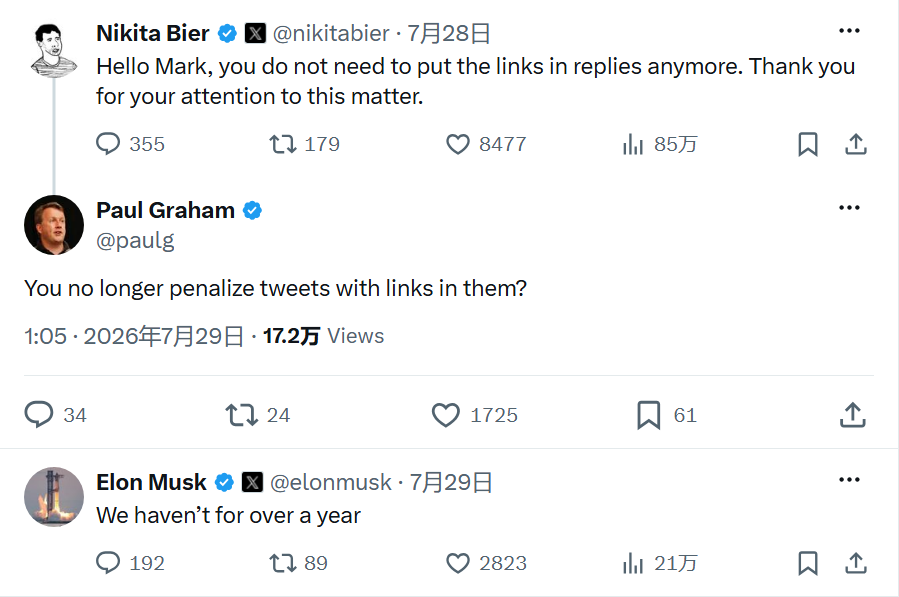
A question that had bothered an entire industry for years was closed by one reply from the owner. From question to authoritative answer, under a day. That is what an algorithm with an owner looks like: there is a person named Musk, you can ask him, and he can answer.
There is a better reply further down the same thread. Someone writing in the first person about “the webviews we shipped last year” added that the penalty was never a rule at all. The ranking model had simply learned that posts with external links push people out of the app and cost predicted engagement, so it pushed them down by itself. When X shipped in-app previews last year, people stopped leaving the app to open a link, the cost the model had learned disappeared, and reach for posts with links came back on its own. Musk himself pointed to the same webview change.
So an entire industry spent years working around a rule nobody ever wrote. They weren’t out of the loop; they were reverse-engineering a learned behavior — one that was finally erased by an unrelated-looking product change, not switched off by anyone.
Why this matters to you
Now ask an AI engine the equivalent question: why did you cite this page last month and drop it this month?
Nobody can answer you. Not because it’s confidential, but because nobody knows — including the people who built it, who happen to be the most expensive engineers on the planet.
The numbers are on the record. OpenAI’s CEO said on a podcast that Meta had offered his staff signing bonuses of up to $100 million. Meta disputed the framing, saying it wasn’t a straight signing bonus but a package of several components, available only for a handful of the most senior roles — discount it to Meta’s version and it is still the price of one person. Another lab’s public job listings in 2026 put base salary for members of technical staff at $1.38 million, and that figure excludes equity.
These people built the model. And they cannot explain why it cites you.
You don’t have to take an outsider’s word for it; they say it more plainly than anyone. OpenAI’s CEO has stated publicly that they have not solved interpretability. More than forty researchers from OpenAI, Google DeepMind, Anthropic and Meta co-signed a paper warning that we can currently glimpse a model’s decision-making by watching it “think out loud,” but that this window is fragile and may close as the technology advances — companies bidding nine figures against each other for the same staff, sitting down to issue a joint warning, tells you something on its own. Anthropic’s CEO wrote a long essay on the urgency of interpretability containing the bluntest line of all: we do not understand how our own creations work, and that is essentially unprecedented in the history of technology.
Zuckerberg has been on both sides of this all summer: posting to X under a rule that expired a year ago, while paying record sums to buy the people who build these models. He can afford the people. He cannot buy a rulebook, because those people don’t have one either.
Let me be precise here, because the loose version of this claim is easy to knock down. Engineers are not powerless.
AI search has two layers. The retrieval layer — which sites make it into the index, how often crawlers return, how much weight freshness carries, whether there are source allowlists — is a real set of engineering settings that real people tune, no different from X’s algorithm. The only difference is that no Nikita Bier comes out to announce the change.
The generation layer is another matter. Why A appeared in the answer and B didn’t, why the same question asked twice gives different results, why a competitor suddenly entered the answer this month — these are behaviors that grew out of training, with no rule anyone can point at and switch off. Engineers can change it (different training data, different alignment work, a different system prompt), but why it turned out the way it did afterwards is something they observe after the fact too.
So the precise statement is this: the people who can change it cannot explain it.
Do you need to act
Nothing on your site needs to change because of this news. What needs to change is how you decide who deserves your money.
Follow “there is no rulebook” one step further and you reach an uncomfortable conclusion: every piece of knowledge in this field has to come from observing the outside. Nobody can extract the answer from within, not even for $100 million a head. That leaves one method — ask the engines yourself, record what you get, and compare answers before and after each rewrite.
Look back at the X story and you get both failure modes of second-hand knowledge in one case. The first is staleness: the “posts with links get suppressed” rule the whole industry lived by had stopped biting more than a year earlier. The second is worse — it was never a rule at all, just a behavior the ranking model learned, which means the “rule” copied from post to post and written into countless guides had been describing the wrong thing from day one. Nobody copying it knew they were wrong, because nobody copying it had measured.
So second-hand isn’t slower first-hand; it is a different thing. First-hand holds the data, so it catches its own errors — you can go back and find the week the answers started looking different. Second-hand has to wait for someone to speak up before it learns it has been working from a wrong premise for a year. X at least had a head of product who eventually said it out loud. AI engines have nobody in that role.
That line splits the GEO market in two. One kind restates: other people’s blog posts, tool vendors’ marketing decks, SEO conventional wisdom from a few years back. Every line sounds right, and not one of them was measured by the person saying it. The other kind runs its own: the same set of questions put to the same set of engines over time, recording who got cited, when it shifted, who dropped after a model refresh. Ask the first kind how long it took them to notice the last rule change and they have nothing. The second kind has an answer, because they hold the data for that stretch of time.
That gap didn’t matter while the rules were stable — everyone copied the same public documentation and nobody was wrong. With no rulebook left to copy, it is the only gap that matters. We took the restating pitch apart once already in the emperor’s new clothes piece, and this news kicks another block out from under it. Evidence runs the other direction too: models can already read the intent of people tampering with a page. You can’t work out its rules; it can work out yours.
So the next time someone tells you they know how the engine ranks right now, ask two things: where did you learn that rule — which official source said it, and when? And the last time it changed, how long before you noticed? If they can’t answer both, they’re guessing, with your budget.
Those two questions apply to us as well. geoweb.tw is backed by CiteTek Inc., which operates as a research company rather than a marketing agency, and its research question is the subject of this article: when nobody can explain an engine’s rules, which conditions are still standing after each rewrite. That only comes from sustained first-hand observation — the same questions put to the same engines over time, citations logged, answers compared before and after each refresh. No other team in Taiwan has this as its core business — that is our read of the public information, and we would genuinely like to hear otherwise, because more people working this question is only good and wrong answers get eliminated faster. You don’t have to take our word for it either: put those two questions to any vendor and see who can produce the data for that stretch of time.
Can you observe it yourself? Of course — asking ChatGPT a few times who it recommends takes no training. Sustaining it is the hard part: one query is an anecdote, and a signal only surfaces once you record across time, across engines, across refreshes, with someone noticing in the same week that this batch of answers looks different. That is a standing commitment, not a weekend project — which is why measurement almost always ends up being part of a managed engagement.
So where should the money go? Into the things that don’t depend on knowing the current rules: content that can be verified, facts that hold up across your pages, consistent mentions from enough external sources, machines that can read what you actually do. Those conditions are worth funding because they are still standing after every model refresh and every rewrite of retrieval logic. Anyone chasing the rules starts over at each refresh, and nobody sends them a notice that it’s time to start over.
Nobody can tell you the date of the next rewrite, and nobody can promise that doing all this gets you cited. Anyone offering that guarantee is selling something. Only one thing is certain: the rulebook you want to buy doesn’t exist — not for the person in Musk’s seat, and not for the person hired at $100 million. What’s left to buy is someone actually watching on your behalf.
If you want to know where you stand right now, managed GEO from geoweb.tw starts with a diagnostic — we look at how you actually appear across AI answers first, then decide whether to move and where.